
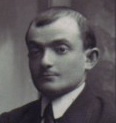
|
Né en 1898 |
Brzeziny Pologne |
Décédé 09-1939 |
Varsovie Pologne |
Melech Fogel had a completely different character. Under the influence of Gips, he began to write poetry and aspired to be regarded as a writer in the minds of Jews.
He was a very interesting type, both in his attitude toward people and also especially in his ambition to become well-known, to extricate himself from small town life and go out into the wider world.
Born in 1898 into a working family of bakers, he barely finished kheyder [elementary school] but taught himself to write not only Yiddish but also Polish and a little Russian and German. And the little that he learned, he had to acquire after his working hours in a tailoring workshop.
After he had finally become a “perfect” pants sewer and was making a good living, he did not think about getting all dressed up and going out to the dance halls as most of his kind did; in his free evening hours, he devoted himself to community work in the arbet-heym [workers home], which brought him closer to the leftist Poale Zion. However, he did not become a party member, and, as a sympathizer, he helped with the work––more on account of his love of people than of the party. In those days, when Gips began to play a role in the new Yiddish poetry, Melech Fogel was also fascinated by the desire to write poetry.
He made many plans to establish his own platform, his own publication in Brzezin. However, nothing came of it. The poems that reflected his populous nature––his virtuous being, his in-love-with-someone soul––were too old-fashioned in style and form to be printed in the publications of the young writers' group in Lodz. He was only published in humorous sections of newspapers, such as “Lamtern” [Lantern] in the Lodzer Togeblat [Lodz Daily Paper] and “Shrapnel” in the Folksblat [People's Paper], but this did not satisfy him. An idea occured to him. He would pay for the publication S'Feld [Domain] that we published in those days, on the condition that his poems would be printed in it.
That is how Melech Fogel's poems got published in two numbers of S'Feld. But again, he was not satisfied, and he decided to publish his own small books of poems. In the years between 1926 and 1939, he published eight books of poems, almost all of which were devoted to local Brzeziner matters––for example, The Terrible Murder in Brzezin, which was published in 1926, and others. This separated him even further from the literary group, which saw Melech Fogel as deviating completely from the usual taste of people and as looking only for his own popularity instead of, as in the beginning, being concerned with Yiddish literature. This, however, did not deter Melech Fogel. And his books more and more had even less to do with poetry.
However, until the Second World War, he always maintained contact with the Lodz writers. He attended every literary event and continued to pay for each issue (knowing that his works would not be printed). In the last weeks before September 1939, he had prepared a large book with old Brzeziner stories and poems for publication and had made an arrangement with a printer (Liebeskind) to distribute it. This was supposed to be his swan song, his contribution to literature and to the hometown that he loved so much, to which he paid tribute in the manner of plain people and dreamt about with tears (he would sing his poems with appropriate melodies and shed tears while singing). But it was not to be that he or his landslayt [fellow townsmen] would enjoy his work of many years.
In the first days of September 1939, after the Germans had already bombed Poland, he came to me with inquiring glances and silent looks, and that is how we ran from one cellar to the other, hiding from German bullets.
During the night of the sixth of September 1939, I decided to leave Lodz and go to Warsaw on foot. On the morning of the seventh of September, I told him that he should come with me to Warsaw. I went to another house to rest myself from the journey and the unmercifully tormenting heat. A half hour later, German planes flew over and bombed almost every house. By some miracle, I narrowly escaped. But when I later went over to Fogel's house, the house was in flames, and Melech Fogel had perished in the flames.
May my words be a memorial candle to their dear souls, for the young lives that so beautifully shone upon.
He was a very interesting type, both in his attitude toward people and also especially in his ambition to become well-known, to extricate himself from small town life and go out into the wider world.
Born in 1898 into a working family of bakers, he barely finished kheyder [elementary school] but taught himself to write not only Yiddish but also Polish and a little Russian and German. And the little that he learned, he had to acquire after his working hours in a tailoring workshop.
After he had finally become a “perfect” pants sewer and was making a good living, he did not think about getting all dressed up and going out to the dance halls as most of his kind did; in his free evening hours, he devoted himself to community work in the arbet-heym [workers home], which brought him closer to the leftist Poale Zion. However, he did not become a party member, and, as a sympathizer, he helped with the work––more on account of his love of people than of the party. In those days, when Gips began to play a role in the new Yiddish poetry, Melech Fogel was also fascinated by the desire to write poetry.
He made many plans to establish his own platform, his own publication in Brzezin. However, nothing came of it. The poems that reflected his populous nature––his virtuous being, his in-love-with-someone soul––were too old-fashioned in style and form to be printed in the publications of the young writers' group in Lodz. He was only published in humorous sections of newspapers, such as “Lamtern” [Lantern] in the Lodzer Togeblat [Lodz Daily Paper] and “Shrapnel” in the Folksblat [People's Paper], but this did not satisfy him. An idea occured to him. He would pay for the publication S'Feld [Domain] that we published in those days, on the condition that his poems would be printed in it.
That is how Melech Fogel's poems got published in two numbers of S'Feld. But again, he was not satisfied, and he decided to publish his own small books of poems. In the years between 1926 and 1939, he published eight books of poems, almost all of which were devoted to local Brzeziner matters––for example, The Terrible Murder in Brzezin, which was published in 1926, and others. This separated him even further from the literary group, which saw Melech Fogel as deviating completely from the usual taste of people and as looking only for his own popularity instead of, as in the beginning, being concerned with Yiddish literature. This, however, did not deter Melech Fogel. And his books more and more had even less to do with poetry.
However, until the Second World War, he always maintained contact with the Lodz writers. He attended every literary event and continued to pay for each issue (knowing that his works would not be printed). In the last weeks before September 1939, he had prepared a large book with old Brzeziner stories and poems for publication and had made an arrangement with a printer (Liebeskind) to distribute it. This was supposed to be his swan song, his contribution to literature and to the hometown that he loved so much, to which he paid tribute in the manner of plain people and dreamt about with tears (he would sing his poems with appropriate melodies and shed tears while singing). But it was not to be that he or his landslayt [fellow townsmen] would enjoy his work of many years.
In the first days of September 1939, after the Germans had already bombed Poland, he came to me with inquiring glances and silent looks, and that is how we ran from one cellar to the other, hiding from German bullets.
During the night of the sixth of September 1939, I decided to leave Lodz and go to Warsaw on foot. On the morning of the seventh of September, I told him that he should come with me to Warsaw. I went to another house to rest myself from the journey and the unmercifully tormenting heat. A half hour later, German planes flew over and bombed almost every house. By some miracle, I narrowly escaped. But when I later went over to Fogel's house, the house was in flames, and Melech Fogel had perished in the flames.
May my words be a memorial candle to their dear souls, for the young lives that so beautifully shone upon.

Fogiel Serge, Bait 48 Hermesh 4489500 Israel - Mobile: 972-53-5253443 - Mail: serge@fogiel.co.il
We are searching for
We are searching for